

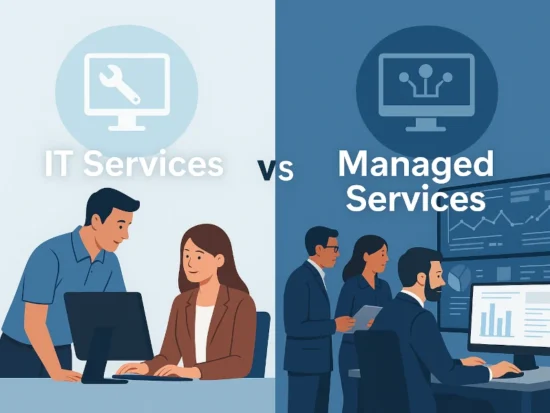
When business owners start exploring ways to improve their technology, two terms appear often: IT services and managed services. They sound similar, but they represent very different support models. Understanding the distinction helps small and medium-sized businesses (SMBs) make the right decision for their operations and budget.
What Are IT Services?
IT services are any technical solutions that help your business operate efficiently — from computer setup and network installations to software support and cybersecurity. These services can be project-based, hourly, or ad hoc, depending on what your company needs at a given time.
Examples of traditional IT services include:
- Computer and network setup
- Hardware and software troubleshooting
- Data backup and recovery
- Email configuration and cloud migration
- Cybersecurity solutions and consulting
In short, IT services are typically reactive — you call when something goes wrong or when you need a specific project completed.
A Managed Service Provider (MSP) like Landon Technologies delivers Managed IT Services that prevent problems before they disrupt your business.

What Are Managed Services?
Managed services go a step further. Instead of waiting for problems to happen, a Managed Service Provider (MSP) like Landon Technologies continuously monitors, maintains, and secures your systems on a proactive basis.
Managed services usually include:
- 24/7 network and system monitoring
- Regular maintenance and patch management
- Help desk and remote support
- Cybersecurity management and threat response
- Cloud backups and disaster recovery
- Strategic IT planning and consulting
The goal is to keep your technology running smoothly while preventing downtime — all for a predictable monthly fee.
According to Gartner’s definition of a Managed Service Provider (MSP), managed services involve outsourcing day-to-day IT management responsibilities to improve operations and reduce costs.
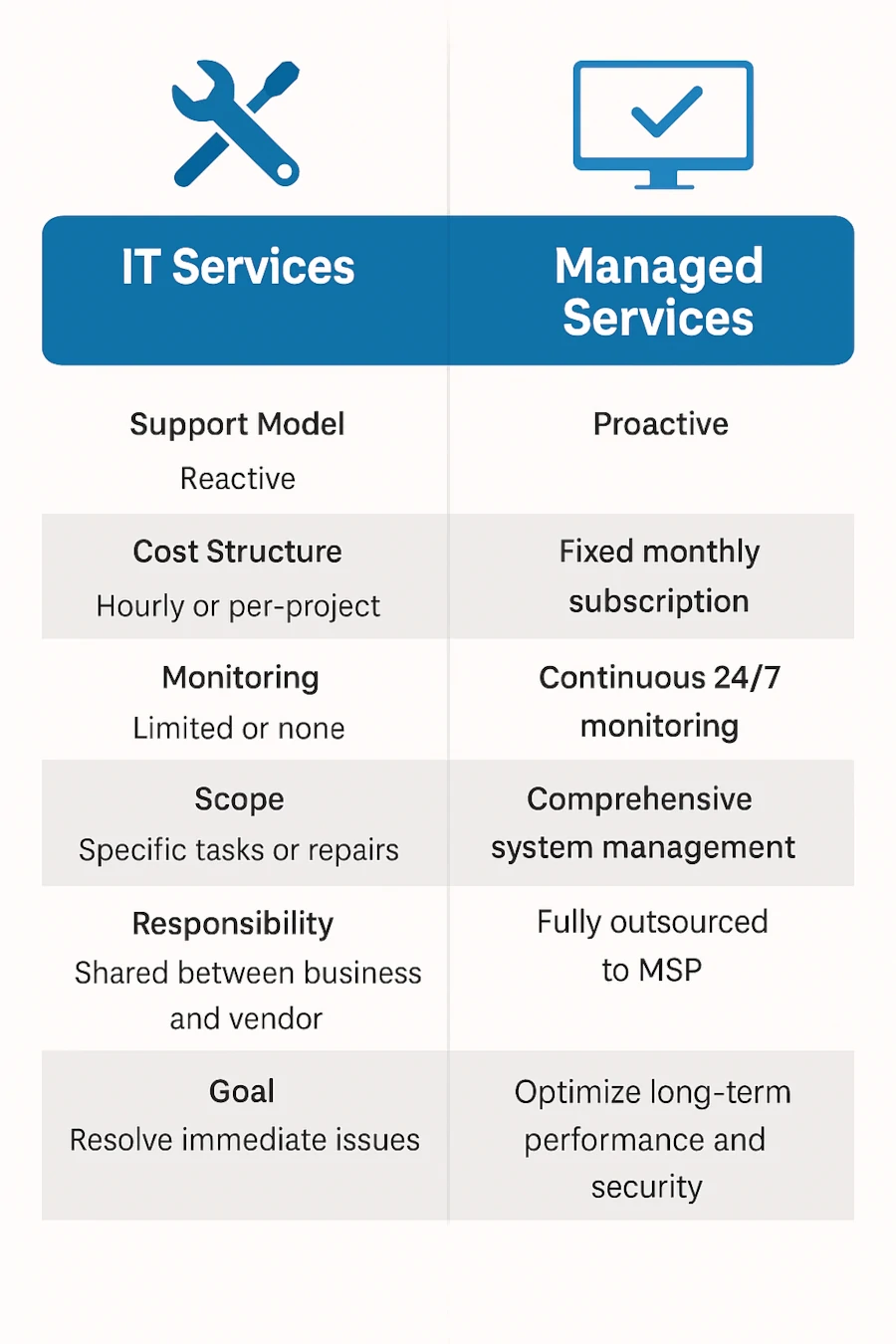
Key Differences Between IT Services and Managed Services
| Feature | IT Services | Managed Services |
|---|---|---|
| Support Model | Reactive (“fix it when it breaks”) | Proactive (“prevent it before it happens”) |
| Cost Structure | Hourly or per-project | Fixed monthly subscription |
| Monitoring | Limited or none | Continuous 24/7 monitoring |
| Scope | Specific tasks or repairs | Comprehensive system management |
| Responsibility | Shared between business and vendor | Fully outsourced to MSP |
| Goal | Resolve immediate issues | Optimize long-term performance and security |
Which Option Is Right for Your Business?
- IT Services are best for small companies with simple networks or limited tech needs — for example, a startup needing occasional computer support or one-time installations.
- Managed Services are ideal for growing SMBs that rely on technology daily and want consistent uptime, security, and predictable budgeting.
If your business depends on cloud applications, remote employees, or compliance requirements, managed services deliver greater value over time.
Why Managed Services Offer More Peace of Mind
Working with a Managed Service Provider means your IT systems are always monitored and updated. You gain access to:
- A dedicated support team
- Faster issue resolution
- Enhanced cybersecurity
- Strategic planning aligned with business goals
At Landon Technologies, we’ve provided managed IT services for small and medium-sized businesses since 2005 — helping companies reduce downtime, strengthen data security, and simplify day-to-day IT operations.
FAQs: Difference in IT Services and Managed IT Services
What is the difference between IT services and managed services?
The main difference between IT services and managed services is that traditional IT services are often reactive and project-based, while managed services are proactive and ongoing. Traditional IT services typically involve fixing problems, completing installations, or handling one-time projects as needed, usually billed hourly or per project. Managed services, on the other hand, provide continuous monitoring, maintenance, cybersecurity, help desk support, backups, and system management through a recurring monthly agreement designed to prevent problems before they occur and keep systems running efficiently.
What are the four types of services?
In business and IT contexts, the four common types of services are often categorized as managed services, professional services, support services, and consulting services. Managed services provide ongoing monitoring and maintenance through recurring agreements, professional services focus on projects such as migrations or installations, support services handle troubleshooting and technical assistance, and consulting services provide strategic guidance, planning, and technology recommendations. Different industries may define service categories differently, but these four are commonly used in the IT services sector.
What is an IT managed service?
An IT managed service is an ongoing technology service provided by a Managed Service Provider (MSP) that proactively monitors, maintains, and supports a business’s IT systems for a recurring monthly fee. Managed services commonly include help desk support, network monitoring, cybersecurity, cloud management, backups, software updates, and proactive maintenance. The goal is to improve reliability, security, and performance while reducing downtime and giving businesses predictable IT support costs instead of relying only on reactive break-fix repairs.
Do I need managed IT services?
Whether you need managed IT services depends on your business size, technology needs, security requirements, and internal IT capabilities, but many small and medium-sized businesses benefit from them because they provide proactive support, cybersecurity, monitoring, backups, and predictable IT costs. Managed IT services can be especially valuable if your business relies heavily on technology, has remote employees, must meet compliance requirements, experiences recurring IT problems, or lacks dedicated internal IT staff. Even businesses with internal IT teams often use managed services for additional cybersecurity, 24/7 monitoring, cloud management, or help desk support.
🔧 Managed IT Services
🔧 Streamline Your IT Operations
Learn how proactive support can boost your business in our
👉 Managed IT Services Blog Category