

Managed IT services are the ongoing monitoring, management, maintenance, and support of a business’s technology by a third-party Managed Service Provider (MSP). Instead of waiting for computers, networks, or other systems to fail, an MSP proactively manages the IT environment to improve reliability, security, and performance.
Depending on the business, managed IT services can include help desk support, computer and server management, network monitoring, cybersecurity, software updates and patching, Microsoft 365 administration, data backup, cloud services, vendor management, and strategic IT planning.
For small and midsize businesses, this approach can provide access to an experienced IT team without requiring the organization to build every technical capability internally. Companies that already have IT employees can also use managed services to supplement their internal team with additional expertise, tools, monitoring, security, or support coverage.
Landon Technologies provides Managed IT Services designed to proactively support and manage business technology while helping organizations reduce downtime, strengthen cybersecurity, and plan for future IT needs.
What Are Managed IT Services?
Managed IT services are an ongoing approach to supporting and managing business technology. Rather than contacting an IT provider only when a problem occurs, an organization assigns defined technology responsibilities to a Managed Service Provider (MSP).
The MSP then takes an active role in maintaining those systems over time.
This can include monitoring computers and servers, managing software updates, supporting employees, maintaining networks, protecting systems against cybersecurity threats, monitoring backups, administering cloud services, and helping the business plan future technology improvements.
What Does “Managed” Mean in Managed IT?
The word “managed” is important because it describes an ongoing responsibility rather than a one-time technical service.
For example, a business could hire an IT technician to install a new computer. That’s an IT service, but it isn’t necessarily a managed IT service.
Under a managed services relationship, the provider may continue to:
- Monitor the computer
- Install operating system updates
- Apply security patches
- Manage endpoint protection
- Track device health
- Troubleshoot problems
- Support the employee using it
- Maintain technical documentation
- Plan for eventual replacement
The difference is ongoing ownership of defined IT responsibilities.
Managed IT Is Proactive Rather Than Primarily Reactive
Traditional IT support often follows a simple pattern:
Something breaks → the business calls for help → a technician repairs it.
Managed IT services add a proactive layer.
An MSP can use remote monitoring and management tools to identify conditions that may require attention, such as:
- Low disk space
- Failed services
- Missing updates
- Backup failures
- Security alerts
- Hardware health problems
- Performance issues
- Offline devices
Technicians can then investigate and address appropriate issues before they create more serious disruption.
Proactive management doesn’t mean technology will never fail. Hardware can break, software can malfunction, internet services can go offline, and cybersecurity incidents can still occur.
The objective is to reduce preventable problems, identify issues earlier, and establish a structured process for responding when something does go wrong.
Managed IT Covers More Than Computers
Modern business technology extends well beyond desktop and laptop computers.
Depending on the organization and service agreement, an MSP may help manage:
- Workstations and laptops
- Servers
- Network infrastructure
- Firewalls and wireless networks
- Microsoft 365
- Cloud services
- User accounts and access
- Cybersecurity systems
- Data backup
- Business applications
- Technology vendors
- Remote employees
- Multiple office locations
This is why managed IT is better understood as an ongoing technology management model rather than a particular software product or individual IT service.
Managed IT Can Supplement an Internal IT Department
Using managed IT services doesn’t necessarily mean outsourcing the entire IT function.
Some businesses use an MSP as their primary IT department, while others have internal IT personnel and use a provider for selected responsibilities.
For example, an internal IT team might manage business applications and strategic projects while an MSP provides endpoint monitoring, help desk support, patch management, cybersecurity, or after-hours coverage.
This approach is commonly known as co-managed IT.
Whether IT is fully managed or co-managed, the underlying principle is the same: specific technology responsibilities are continuously managed rather than handled only when a problem occurs.
What Do Managed IT Services Include?
The services included in a managed IT agreement vary depending on the provider and the needs of the business. Some organizations need an MSP to manage nearly their entire technology environment, while others use managed services for specific systems or to supplement an internal IT team.
A comprehensive managed IT service may include the following areas.
Help Desk and End-User Support
Employees need technical assistance when they encounter problems with computers, applications, email, passwords, printers, connectivity, or other everyday technology.
An IT Help Desk gives users a defined resource for requesting assistance and allows technical issues to be tracked, prioritized, escalated, and documented.
Many problems can be resolved remotely, reducing the need to wait for a technician to physically visit the office.
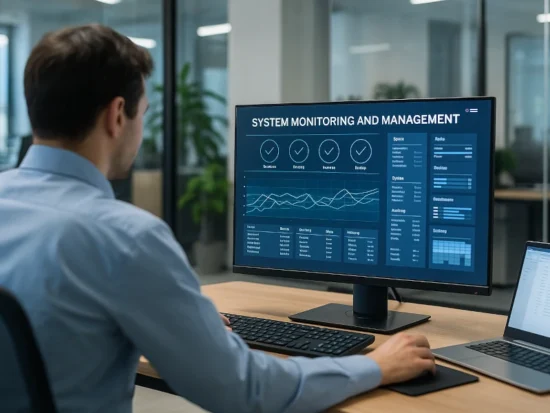
Remote Monitoring and IT Management
Managed IT providers use monitoring and management tools to maintain visibility into supported technology.
Depending on the environment, monitoring may include:
- Computers
- Servers
- Critical services
- Storage capacity
- System performance
- Hardware health
- Backup status
- Security software
- Network connectivity
Alerts can help technicians identify developing problems and investigate them before they result in more significant downtime.
Software Updates and Patch Management
Operating systems and applications require regular updates to correct bugs, improve reliability, and address security vulnerabilities.
An MSP can establish a structured Patch Management process rather than depending on individual employees to keep business computers updated.
This can include deploying approved updates, monitoring installation status, identifying devices that are missing patches, and troubleshooting failed updates.
Cybersecurity
Cybersecurity has become a fundamental component of managed IT.
Depending on the service agreement, an MSP may help manage:
- Endpoint protection
- Endpoint detection and response
- Managed detection and response
- Multifactor authentication
- Email security
- DNS filtering
- Security monitoring
- Vulnerability management
- Security awareness training
- Access controls
- Security policies
Effective Cybersecurity Services use multiple layers of protection because no single security product can address every threat.
Network Management
Business networks connect employees with internet services, cloud applications, printers, servers, phones, wireless devices, and other resources.
Managed Network Services can include monitoring, troubleshooting, configuration management, firewall support, wireless network management, and planning for infrastructure improvements.
For organizations with multiple locations, network management may also involve maintaining reliable connectivity between offices and cloud resources.
Microsoft 365 and Cloud Management
Cloud platforms have become a core part of many business IT environments.
Managed IT services may include Microsoft 365 responsibilities such as:
- User account administration
- Exchange Online
- Microsoft Teams
- OneDrive
- SharePoint
- Licensing
- Multifactor authentication
- Security configuration
- Email troubleshooting
- User onboarding and offboarding
Professional Microsoft 365 Management can help businesses maintain the platform as an actively managed part of their IT environment rather than treating it as simply another software subscription.
Data Backup and Disaster Recovery
Backups help protect business information against accidental deletion, hardware failure, ransomware, software problems, theft, and other forms of data loss.
Managed backup services may include:
- Automated backups
- Backup monitoring
- Offsite or cloud storage
- Server backup
- Workstation backup
- Cloud-data backup
- Restore assistance
- Recovery planning
An important part of managed backup is verifying that backup jobs are actually completing successfully rather than assuming that data is protected because backup software was installed.
Server Management
Businesses that operate physical or virtual servers may need ongoing server monitoring, maintenance, patching, troubleshooting, and performance management.
Server responsibilities can include operating systems, storage, applications, permissions, backups, security, and hardware health.
Proactive Server Support can help identify problems before they result in outages affecting multiple employees or critical business applications.
On-Site IT Support
Although many IT issues can be resolved remotely, some problems require physical access to equipment.
Depending on the service agreement and location, On-Site IT Support may be used for hardware problems, network equipment, server issues, installations, office projects, or situations that cannot reasonably be resolved remotely.
Businesses should understand whether onsite assistance is included in their managed service, provided through an allowance, or billed separately.
Vendor Management
A business may rely on numerous technology vendors, including:
- Internet providers
- Software companies
- Phone providers
- Copier vendors
- Cloud platforms
- Hardware manufacturers
- Line-of-business application providers
When a problem involves multiple systems, determining which vendor is responsible can consume significant employee time.
An MSP may coordinate with these third parties on the customer’s behalf, giving the business a central technical resource for resolving issues that cross vendor boundaries.
User Onboarding and Offboarding
Adding and removing employees involves numerous IT and cybersecurity tasks.
For a new employee, the MSP may help configure a computer, create accounts, assign licenses, establish permissions, deploy applications, and prepare access to company resources.
When an employee leaves, the process can include disabling accounts, removing access, preserving company data, recovering licenses, and securing equipment.
Standardizing these procedures helps improve both efficiency and security.
Strategic IT Consulting and Planning
Managed IT should also help businesses prepare for future technology needs.
Ongoing IT Consulting Services can help organizations plan for:
- Computer and server replacements
- Network upgrades
- Cybersecurity improvements
- Cloud migrations
- New business applications
- Office expansions
- Technology budgets
- Business continuity
- Long-term IT strategy
This strategic component is an important distinction between simply fixing technical problems and actively managing technology as an ongoing business function.
The exact combination of services depends on the organization and its agreement with the MSP. Businesses should therefore review the scope carefully rather than assuming that every provider includes the same services under the term “managed IT services.”
How Do Managed IT Services Work?
Managed IT services typically begin with an assessment of the business’s existing technology environment. From there, the Managed Service Provider establishes the tools, documentation, security controls, and support processes needed to manage the systems covered by the agreement.
Although every MSP operates differently, the process generally includes several stages.
1. Assessing the IT Environment
Before an MSP can effectively manage a business’s technology, it needs to understand what is already in place.
The provider may review:
- Computers and laptops
- Servers
- Network equipment
- Internet connectivity
- Microsoft 365 and cloud services
- Business applications
- Cybersecurity protections
- Backup systems
- Existing vendors
- User accounts
- Aging or unsupported technology
This assessment helps identify immediate technical problems, security gaps, outdated systems, and areas that may need improvement before ongoing management begins.
2. Defining the Scope of Management
The business and MSP determine which users, devices, locations, systems, and services will be covered.
For example, the provider may assume responsibility for employee computers, servers, networks, Microsoft 365, cybersecurity, backups, and end-user support.
The scope should also identify responsibilities that remain with the business or another technology provider.
This is important because managed IT doesn’t necessarily mean the MSP manages every piece of technology the organization uses.
3. Onboarding and Documentation
Once the scope is established, the MSP begins onboarding the environment.
This may involve:
- Installing monitoring and management software
- Deploying endpoint security tools
- Configuring patch management
- Verifying backups
- Documenting network infrastructure
- Recording hardware and software information
- Establishing administrative access
- Documenting technology vendors
- Creating support procedures
- Identifying critical systems and applications
Good documentation allows authorized technicians to understand the environment without relying entirely on one person’s knowledge.
4. Proactive Monitoring
After onboarding, the MSP can continuously monitor supported systems for conditions that require attention.
Depending on the environment, this can include:
- Device availability
- System performance
- Disk capacity
- Hardware health
- Critical services
- Backup status
- Security alerts
- Network connectivity
- Software and patch status
When monitoring detects a problem, technicians can investigate and determine whether corrective action is required.
In some cases, the issue can be resolved before employees even realize something is wrong.
5. Preventive Maintenance
Monitoring identifies problems, while maintenance helps prevent them.
An MSP may routinely perform tasks such as:
- Installing approved updates
- Applying security patches
- Addressing failed updates
- Reviewing device health
- Maintaining security software
- Checking backup status
- Resolving recurring system issues
- Removing unsupported technology
This ongoing maintenance is a major difference between managed IT and a purely reactive support model.
6. Supporting Employees
Managed IT also provides a structured way for employees to receive technical assistance.
When a user experiences an issue, the support team can create a ticket, troubleshoot the problem, document the work, and escalate the request when necessary.
Many problems can be handled through Remote IT Support, allowing technicians to securely access supported systems and assist employees without waiting for an onsite visit.
More complex issues can be escalated to technicians with the appropriate expertise or handled onsite when physical access is required.
7. Managing Cybersecurity and Backups
Security and data protection require ongoing attention.
An MSP may monitor security tools, apply patches, manage endpoint protection, review alerts, maintain account-security controls, monitor backups, and respond to problems involving protected systems.
The goal isn’t simply to install cybersecurity and backup products during onboarding.
Those systems need to remain configured, monitored, updated, and operational over time.
8. Reporting and Reviewing the Environment
Managed IT providers may also review the health and status of the environment periodically.
Depending on the provider and agreement, reporting can cover areas such as:
- Device health
- Support activity
- Patch status
- Backup status
- Security
- Hardware lifecycle
- Recurring technical problems
- Upcoming technology needs
The purpose of reporting shouldn’t simply be to produce statistics. The information should help identify risks, trends, and areas requiring attention.
9. Planning Future IT Improvements
The technology environment continues to change after onboarding.
Employees are hired and leave. Computers age. Software reaches end of support. Cybersecurity threats evolve. Businesses open locations, adopt new applications, and move more systems to the cloud.
An MSP can use its ongoing knowledge of the environment to help plan for those changes.
This creates a continuous cycle:
Assess → Manage → Monitor → Maintain → Support → Secure → Review → Improve
Rather than treating IT as a collection of unrelated repair calls, managed IT establishes an ongoing process for keeping business technology supported, maintained, secure, documented, and aligned with the organization’s needs.
Managed IT Services vs. Break-Fix IT Support
One of the easiest ways to understand managed IT services is to compare them with the traditional break-fix IT support model.
With break-fix support, a business typically contacts an IT provider after a technical problem has already occurred. The provider diagnoses the issue, performs the necessary work, and bills the customer for the service.
Managed IT services establish an ongoing relationship in which the provider continuously manages defined areas of the technology environment.
How Break-Fix IT Support Works
The traditional break-fix model is primarily reactive.
The process generally looks like this:
A problem occurs → the business contacts an IT provider → a technician investigates → the problem is repaired → the business is billed for the work.
Break-fix services can be appropriate for individual projects, occasional technical assistance, or organizations that already have the resources to manage their own IT environment.
However, the provider may have little involvement with the technology between service calls.
That can leave responsibilities such as monitoring, patching, backups, cybersecurity, documentation, and long-term technology planning with the business.
How Managed IT Services Are Different
Managed IT shifts the relationship from individual repair calls toward ongoing technology management.
Instead of becoming involved only after something fails, the MSP may continuously:
- Monitor supported systems
- Maintain computers and servers
- Deploy updates and security patches
- Manage cybersecurity tools
- Monitor backups
- Support employees
- Maintain documentation
- Manage networks and cloud services
- Coordinate technology vendors
- Plan future improvements
The provider becomes familiar with the environment because it is actively involved in managing it over time.
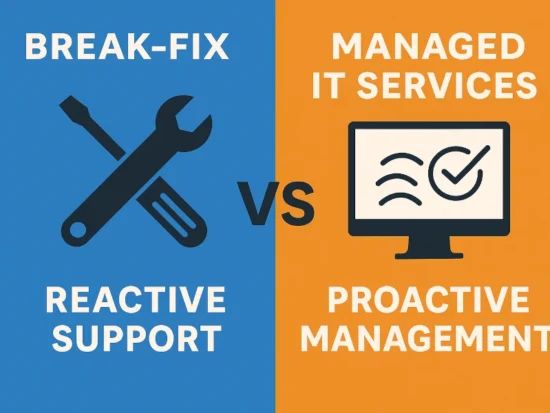
Reactive vs. Proactive IT Support
The fundamental difference is when and why the IT provider becomes involved.
Break-fix IT:
The provider is typically contacted because a problem has already occurred.
Managed IT:
The provider is continuously involved in maintaining and supporting the environment while also responding when problems occur.
Managed IT is still reactive when necessary. Employees will still encounter software problems, hardware can still fail, and unexpected outages can still occur.
The difference is that reactive support exists alongside monitoring, maintenance, security, documentation, and planning.
Predictable Monthly Service vs. Individual Repair Bills
Break-fix IT is commonly billed according to the time or project required to resolve a problem.
Managed IT is typically structured around a recurring service agreement covering a defined scope of responsibilities.
That can make routine IT expenses more predictable, but businesses should understand exactly what the monthly service includes.
Hardware purchases, major projects, software licensing, cabling, migrations, or other work may still be billed separately depending on the agreement.
Different Incentives
The two models can also create different service incentives.
Under break-fix support, the provider earns revenue when technical work is required.
With managed IT, recurring problems consume the MSP’s support resources without necessarily generating additional revenue when the work is included in the monthly agreement.
That gives the provider a practical incentive to:
- Reduce recurring problems
- Standardize technology
- Maintain systems properly
- Automate routine tasks
- Keep devices updated
- Improve documentation
- Identify problems earlier
A more stable IT environment can benefit both the customer and the provider.
Managed IT vs. Break-Fix at a Glance
| Break-Fix IT | Managed IT Services |
|---|---|
| Primarily reactive | Proactive and reactive |
| Provider called when needed | Ongoing provider relationship |
| Often hourly or project billing | Usually recurring service agreement |
| Limited continuous monitoring | Proactive monitoring may be included |
| Maintenance handled separately | Ongoing maintenance may be included |
| Provider may have limited environment knowledge | MSP maintains ongoing knowledge and documentation |
| Security may be a separate project | Cybersecurity can be integrated into ongoing management |
| Technology planning may be occasional | Ongoing IT planning can be part of the relationship |
Which IT Support Model Is Better?
Neither model is automatically appropriate for every organization.
A business with experienced internal IT personnel may only need outside assistance for occasional projects or specialized technical work.
However, organizations that need ongoing help desk support, monitoring, cybersecurity, maintenance, backups, documentation, and technology planning may benefit more from a managed services model.
For an even deeper comparison of these service models, see IT Services vs. Managed Services: What’s the Difference?.
The key question is whether the organization needs someone to repair technology occasionally or assume ongoing responsibility for managing it.
Benefits of Managed IT Services
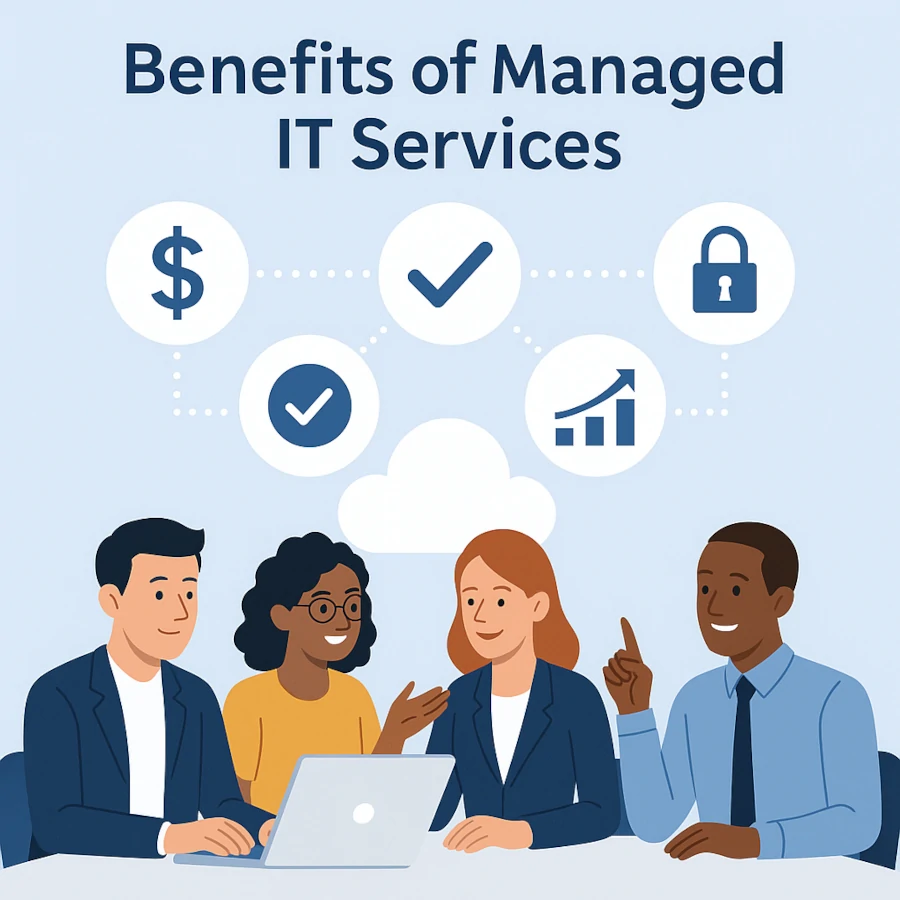
Managed IT services can provide more than technical support when something goes wrong. By continuously managing, maintaining, and supporting the technology environment, an MSP can help improve reliability, cybersecurity, productivity, and long-term technology planning.
The specific benefits depend on the services included and the needs of the organization, but several advantages are common.
More Predictable IT Costs
Unexpected technology problems can create unpredictable expenses.
Under a managed services model, many recurring IT responsibilities are incorporated into an ongoing monthly service agreement. This can make routine support and management expenses easier to budget than relying primarily on individual repair calls.
Businesses may still have separate expenses for hardware, software licenses, major projects, migrations, cabling, or other services outside the agreement.
The advantage is greater predictability around the recurring IT services the organization uses regularly.
Reduced Downtime
Technology problems can prevent employees from accessing email, applications, files, networks, cloud services, and other resources they need to work.
Proactive monitoring and maintenance can help identify conditions such as:
- Hardware health problems
- Low storage capacity
- Failed services
- Missing updates
- Backup failures
- Security alerts
- Network connectivity issues
- Performance problems
Not every outage can be prevented, but identifying developing problems earlier can reduce the likelihood that smaller issues turn into significant disruptions.
Stronger Cybersecurity
Cybersecurity requires ongoing management.
Security software needs to remain updated, operating systems need patches, user access changes, new vulnerabilities are discovered, employees need guidance, and security alerts may require investigation.
An MSP can help coordinate these different layers rather than treating cybersecurity as a one-time installation.
This is especially valuable for organizations that don’t employ dedicated cybersecurity personnel.
Faster Access to Technical Support
Employees lose productive time when they have to troubleshoot technology themselves or determine who to contact for assistance.
A managed IT relationship gives users an established support resource.
The MSP is also already familiar with the organization’s technology environment, which can make troubleshooting more efficient than repeatedly engaging a provider that has little knowledge of the systems involved.
Access to Broader IT Expertise
Modern business technology spans many disciplines.
An organization may need expertise involving:
- Microsoft 365
- Windows and macOS
- Networking
- Cybersecurity
- Cloud services
- Servers
- Backup and recovery
- Endpoint management
- Business applications
- Hardware
- IT strategy
Building an internal team with deep expertise in every area can be expensive, particularly for small and midsize businesses.
An MSP can provide access to multiple technical resources with different areas of expertise.
Improved Employee Productivity
IT problems don’t have to cause a complete outage to affect productivity.
Slow computers, unreliable Wi-Fi, login problems, email issues, software errors, and recurring technical frustrations can consume small amounts of employee time throughout the day.
Proactive maintenance and responsive support can reduce these interruptions and give employees somewhere to turn when they encounter problems.
The objective is to help employees spend less time troubleshooting technology and more time performing their actual work.
Better Support for Business Growth
Technology requirements often become more complicated as a business grows.
Adding employees can require new computers, accounts, licenses, applications, security controls, and support.
Opening another office may require internet connectivity, network infrastructure, wireless coverage, cybersecurity, cloud access, and standardized equipment.
An MSP that already understands the business can help plan and implement these changes more consistently.
Greater IT Continuity
Businesses that depend heavily on one employee or individual technician for technology can face continuity risks.
Important knowledge may exist only in one person’s memory. Support may become difficult when that person is unavailable, overloaded, on vacation, or leaves the organization.
A managed services provider can reduce that dependence through:
- Technical documentation
- Standardized procedures
- Centralized support
- Multiple technical resources
- Defined escalation processes
- Ongoing monitoring
This creates a more resilient support structure than relying entirely on one individual.
Better Technology Planning
Without ongoing IT planning, businesses can fall into a cycle of replacing equipment only after it fails and addressing technology issues only when they become urgent.
An MSP can help identify future needs such as:
- Aging computers
- Server replacements
- Unsupported software
- Network upgrades
- Cybersecurity improvements
- Cloud migrations
- New office locations
- Business continuity requirements
Planning ahead allows technology investments to become part of the organization’s normal budgeting and decision-making process rather than emergency expenses.
Scalability
Managed IT services can adapt as the organization changes.
Businesses may add or remove employees, adopt new applications, expand into additional locations, increase cybersecurity requirements, or shift more operations to the cloud.
A scalable managed services relationship allows IT resources and support capabilities to evolve alongside those changes.
A More Proactive Approach to Technology
Ultimately, one of the biggest benefits of managed IT services is the shift in how technology is treated.
Instead of viewing IT primarily as something that requires attention when it breaks, the organization can manage technology as an ongoing business function.
That means continuously considering:
Is it reliable?
Is it secure?
Is it maintained?
Is it documented?
Can employees get help?
Will it support where the business is going next?
That proactive approach can make technology more predictable and better aligned with the organization’s operations and long-term goals.
Managed IT Network Services and Monitoring
A reliable network is fundamental to almost every part of a modern business IT environment. Employees depend on network connectivity to access the internet, cloud applications, Microsoft 365, shared resources, printers, servers, phones, and other business systems.
For this reason, network management and monitoring are commonly important components of managed IT services.
What Are Managed IT Network Services?
Managed IT network services involve an MSP taking ongoing responsibility for defined parts of a business’s network infrastructure.
Depending on the environment and service agreement, this can include:
- Routers
- Firewalls
- Network switches
- Wireless access points
- Internet connectivity
- Local area networks
- Virtual private networks (VPNs)
- Network-connected servers
- Multiple office locations
- Remote connectivity
Rather than addressing network problems only after employees lose connectivity, the MSP can maintain visibility into supported network infrastructure and respond to issues as they develop.
What Is Managed IT Monitoring?
Managed IT monitoring uses software and management tools to watch supported technology for conditions that may require attention.
Monitoring can apply to more than networks. An MSP may monitor:
- Computers
- Servers
- Network devices
- Storage capacity
- System performance
- Critical services
- Backup jobs
- Security software
- Hardware health
- Internet or network connectivity
When a monitoring system detects a condition outside an established threshold or identifies a device or service that is unavailable, it can generate an alert for investigation.
What Can Network Monitoring Detect?
Depending on the equipment and monitoring tools being used, network monitoring may help identify issues such as:
- Network devices going offline
- Connectivity failures
- High resource utilization
- Device performance problems
- Interface or bandwidth conditions
- Hardware issues
- Service interruptions
- Communication failures between systems
Monitoring doesn’t automatically mean every problem can be prevented or repaired without interruption.
Its value is visibility.
Without monitoring, an IT provider may not know a network device or service has failed until an employee reports the problem.
With monitoring in place, the provider may be alerted sooner and can begin investigating the issue.
Network Management Goes Beyond Monitoring
Monitoring tells the MSP what is happening. Network management involves maintaining and supporting the environment itself.
This can include:
- Troubleshooting connectivity problems
- Managing network configurations
- Maintaining firewalls
- Supporting wireless networks
- Applying appropriate firmware updates
- Replacing aging equipment
- Planning network improvements
- Documenting infrastructure
- Coordinating with internet providers
- Supporting new office locations
Businesses that are expanding or experiencing recurring connectivity problems may also need improvements to their underlying Network Infrastructure rather than simply additional monitoring.
Managed Wi-Fi and Wireless Networks
Wireless connectivity has become critical for laptops, mobile devices, conference rooms, guest networks, and many other business applications.
An MSP may help manage:
- Wireless access points
- Wi-Fi coverage
- Wireless security
- Network segmentation
- Guest wireless access
- Connectivity troubleshooting
- Access point placement
- Wireless upgrades
Businesses experiencing poor coverage, dead zones, unreliable connections, or increasing device density may require a professional Wireless Network Installation or redesign.
Managing Networks Across Multiple Locations
Organizations with several offices can have additional networking challenges.
Each location may have its own:
- Internet connection
- Firewall
- Switches
- Wireless network
- Local equipment
- Users and devices
Centralized monitoring and standardized network configurations can make these environments easier to support.
The MSP can also help coordinate internet providers, network equipment, connectivity, and troubleshooting across locations rather than treating every office as an unrelated IT environment.
Why Network Management Matters to Managed IT
A computer can be functioning perfectly while the employee using it is unable to work because the network is unavailable.
Likewise, cloud applications, VoIP phones, Microsoft 365, remote access, and many business systems depend on reliable connectivity.
That is why managed IT should consider the network as part of the overall technology environment, not simply the computers connected to it.
Professional Network Services can complement endpoint management, cybersecurity, cloud administration, and user support to create a more complete managed IT strategy.
Who Needs Managed IT Services?
Managed IT services can be useful for organizations of many different sizes. The deciding factor isn’t necessarily the number of employees—it’s how important technology has become to the organization’s daily operations and whether the business has the resources to manage that technology effectively.
Several situations can indicate that a business may benefit from managed IT services.
Small Businesses Without Internal IT Staff
Many small businesses depend heavily on technology but don’t have a dedicated IT department.
Employees still need support for computers, email, Microsoft 365, networks, cloud applications, cybersecurity, backups, and other systems.
Without dedicated IT resources, technical responsibilities may fall to an owner, office manager, or employee whose primary job has nothing to do with technology.
A managed IT provider can give the organization access to an established IT team without requiring it to build a complete internal department.
Businesses in this situation may benefit from Managed IT Services for Small Businesses that combine ongoing support, monitoring, maintenance, security, and technology planning.
Growing Businesses
Technology requirements often become more complicated as a company grows.
Adding employees can mean adding:
- Computers
- User accounts
- Microsoft 365 licenses
- Business applications
- Security controls
- Network capacity
- Remote access
- Help desk requirements
Opening additional locations can introduce even more infrastructure and connectivity requirements.
An MSP can help standardize these processes so the technology environment remains manageable as the organization expands.
Businesses With Limited Internal IT Resources
Some organizations already employ an IT manager, system administrator, or small technical team but still need additional resources.
Internal IT personnel may be responsible for everything from employee support and cybersecurity to infrastructure, business applications, projects, and strategic planning.
An MSP can supplement the internal team with additional help desk capacity, monitoring, security tools, specialized expertise, project resources, or support coverage.
This approach is commonly known as Co-Managed IT Services.
Businesses Experiencing Frequent IT Problems
Recurring technical problems can indicate that an organization needs a more structured approach to IT management.
Examples include:
- Repeated computer problems
- Unreliable networks or Wi-Fi
- Recurring server issues
- Frequent application problems
- Failed or unverified backups
- Inconsistent software updates
- Employees regularly losing time to IT issues
- Technology being replaced only after failure
Managed IT can help identify recurring problems, establish standards, improve documentation, and introduce proactive maintenance.
Organizations Concerned About Cybersecurity
Cybersecurity has become difficult for businesses to manage informally.
Protecting an organization may require multiple layers involving endpoints, email, identities, networks, cloud platforms, backups, software updates, and employee awareness.
Businesses without dedicated security resources may benefit from an MSP that incorporates cybersecurity into ongoing IT management.
This is particularly important when the organization handles sensitive information, must meet contractual security requirements, or needs to demonstrate security controls to customers, insurers, or other stakeholders.
Businesses With Remote Employees
Remote and hybrid work create additional IT support challenges.
Employees may work from home, travel, or operate from locations far from the company’s main office.
They still need:
- Secure access
- Reliable computers
- Microsoft 365
- Cloud applications
- Cybersecurity protection
- Software updates
- Technical support
Managed IT services can provide centralized management and support for employees regardless of whether everyone works in the same building.
Multi-Location Businesses
Organizations with several offices need consistent technology standards across different locations.
Each office may have computers, internet connections, firewalls, wireless networks, printers, phones, and other equipment that requires support.
An MSP can help standardize and manage these environments while providing a central point of contact for technology issues.
For organizations operating across different geographic markets, Nationwide IT Support can help extend consistent technical support beyond a single local office.
Businesses That Depend Heavily on Technology
Some organizations can tolerate a temporary technology problem with relatively little disruption.
For others, losing access to email, internet connectivity, business applications, cloud services, customer information, or shared files can quickly affect operations.
The more dependent the organization is on technology, the more valuable proactive management, monitoring, security, support, backup, and planning can become.
Businesses That Need Better IT Planning
Managed IT can also make sense when an organization needs help answering longer-term technology questions.
For example:
- Which computers should be replaced next?
- Is the server approaching end of life?
- Does the network need to be upgraded?
- Are cybersecurity protections sufficient?
- Should an application move to the cloud?
- What technology will be needed for another office?
- What should the company budget for IT next year?
An ongoing MSP relationship gives the provider enough familiarity with the environment to help answer these questions before they become emergencies.
When Does Managed IT Make Sense?
A business doesn’t need to reach a particular number of employees before considering managed IT services.
A better indicator is whether the organization needs someone to take ongoing responsibility for supporting, maintaining, monitoring, securing, and planning its technology.
When IT has become too important to manage informally or only address when something breaks, a managed services model may be appropriate.
Managed IT Services for Small and Midsize Businesses
Small and midsize businesses often reach a point where their technology requirements exceed what can reasonably be managed informally, but building a large internal IT department may not make financial or operational sense.
Managed IT services can help bridge that gap.
Instead of hiring separate employees to handle help desk support, networking, Microsoft 365, cybersecurity, backups, endpoint management, and other technology responsibilities, a business can use an MSP to provide access to a broader range of IT resources.
An Extension of Your Business
For organizations without internal IT staff, an MSP can function as the primary technology support team.
Employees have a defined resource for technical assistance, while the provider manages the systems, security, monitoring, maintenance, and other responsibilities included in the agreement.
The MSP also develops familiarity with the organization’s technology over time, including its users, devices, applications, infrastructure, vendors, and business requirements.
Support for Internal IT Teams
For midsize businesses with existing IT personnel, managed services can serve a different purpose.
Instead of replacing the internal team, the MSP can assume selected responsibilities such as:
- Help desk support
- Endpoint monitoring
- Patch management
- Cybersecurity
- Backup monitoring
- After-hours support
- Network monitoring
- Specialized technical work
This can allow internal IT personnel to spend more time on business-specific applications, projects, strategic initiatives, and other responsibilities that require their direct involvement.
Enterprise-Level IT Capabilities Without an Enterprise-Sized Team
Small and midsize businesses increasingly rely on many of the same technologies used by larger organizations.
They also face many of the same requirements involving cybersecurity, cloud services, data protection, remote work, business continuity, and reliable access to technology.
Managed IT services can give these organizations access to professional tools, established processes, documentation, monitoring, security technologies, and specialized expertise without requiring every capability to be built internally.
A Service Model That Can Grow With the Business
The technology needs of a 10-person company may look very different several years later if the organization adds employees, locations, applications, cloud services, or more demanding cybersecurity requirements.
A managed services relationship can evolve as those needs change.
The objective is not simply to solve today’s IT problems, but to establish a support and management structure capable of growing alongside the organization.
What Is a Managed Service Provider (MSP)?
A Managed Service Provider (MSP) is a company that assumes ongoing responsibility for managing, supporting, monitoring, and maintaining defined areas of another organization’s technology environment.
Instead of being contacted only when a computer or system breaks, an MSP maintains an ongoing relationship with the business and provides the services established in a managed IT agreement.
What Does an MSP Do?
The exact responsibilities of an MSP depend on the customer’s technology environment and service agreement.
An MSP may be responsible for areas such as:
- Help desk and end-user support
- Computers and laptops
- Servers
- Network infrastructure
- Cybersecurity
- Software updates and patch management
- Microsoft 365
- Cloud services
- Data backup
- User accounts
- Technology vendors
- IT documentation
- Technology planning
Some MSPs provide comprehensive management of nearly the entire IT environment, while others specialize in particular technologies or work alongside an organization’s internal IT department.
How Is an MSP Different From an IT Support Company?
The distinction is primarily the ongoing management relationship.
A traditional IT support company may be hired to repair a computer, install a server, configure a network, complete a migration, or troubleshoot a particular problem.
An MSP can perform many of those same technical tasks, but it also assumes continuing responsibility for the systems and services covered by the agreement.
That can include monitoring systems between support requests, maintaining documentation, applying updates, managing security, reviewing backups, supporting users, and helping plan future technology needs.
In other words, an MSP is not defined simply by the technical work it performs, but by its ongoing responsibility for managing technology over time.
Does an MSP Replace an Internal IT Department?
Not necessarily.
For a business without dedicated IT personnel, the MSP may function as its primary IT team.
For organizations that already employ IT staff, an MSP may provide additional resources or assume specific responsibilities.
For example, the internal team might manage strategic projects and specialized business applications while the MSP handles:
- Help desk requests
- Endpoint management
- Monitoring
- Patch management
- Cybersecurity
- Backups
- After-hours support
This co-managed approach allows businesses to combine internal knowledge with additional external resources.
How Does an MSP Manage Technology Remotely?
Many MSP services can be delivered remotely using specialized management and support tools.
These tools may allow authorized technicians to:
- Monitor device health
- Receive alerts
- Deploy software
- Install updates
- Review system information
- Manage security tools
- Troubleshoot problems
- Remotely assist users
Remote management allows an MSP to support technology across different offices and geographic locations without requiring a technician to be physically present for every issue.
When a problem does require hands-on work, remote management can still help the provider diagnose the issue and determine what needs to be done before onsite assistance is arranged.
The MSP Becomes an Ongoing Technology Partner
Because an MSP works with the environment continuously, the provider can develop knowledge of the organization’s systems, employees, applications, vendors, security requirements, and future technology needs.
That ongoing familiarity can help the MSP identify recurring problems, recommend improvements, plan replacements, standardize systems, and support changes as the business grows.
The goal of an MSP relationship is therefore broader than simply providing technical assistance.
It is to establish ongoing accountability for defined areas of the organization’s technology environment.
How Much Do Managed IT Services Cost?
The cost of managed IT services varies because businesses have different numbers of users, devices, locations, systems, security requirements, and support needs.
Rather than having one standard price for every organization, Managed Service Providers typically determine pricing based on the technology environment and the responsibilities included in the service agreement.
Common Managed IT Pricing Models
MSPs may structure managed IT pricing in several ways.
Per-user pricing charges a recurring amount for each supported employee. This can simplify budgeting when individual users have multiple devices or cloud accounts.
Per-device pricing bases the monthly cost on the number and type of managed devices, such as workstations, laptops, servers, firewalls, or other equipment.
Flat-rate pricing provides an agreed monthly price for a defined scope of managed services.
Tiered plans offer different packages based on the services and level of support included.
Customized pricing is developed around the organization’s specific technology environment and requirements.
Some providers use a combination of these approaches.
What Affects the Cost of Managed IT Services?
Several factors can influence managed IT pricing, including:
- Number of employees
- Number of computers and devices
- Servers
- Office locations
- Remote employees
- Network complexity
- Microsoft 365 requirements
- Cybersecurity requirements
- Backup and recovery needs
- Help desk coverage
- Support hours
- Onsite support requirements
- Cloud infrastructure
- Internal IT resources
- Compliance or security requirements
A small organization with a straightforward cloud-based environment will generally have different support requirements than a multi-location business operating servers, specialized applications, complex networks, and more advanced cybersecurity controls.
What Is Included in the Monthly Fee?
This is one of the most important questions to ask when comparing managed IT providers.
A monthly managed services fee may include areas such as:
- Help desk support
- Remote support
- Monitoring
- Patch management
- Endpoint management
- Cybersecurity
- Backup monitoring
- Network management
- Microsoft 365 administration
- Vendor coordination
- IT consulting
However, not every MSP includes the same services.
Businesses should compare the actual scope rather than assuming two similarly priced managed IT offerings provide equivalent coverage.
Are There Additional IT Costs?
Yes. A managed IT agreement doesn’t necessarily include every technology expense a business may encounter.
Depending on the provider and agreement, separate costs can include:
- Computers and other hardware
- Software licensing
- Microsoft 365 licensing
- Major projects
- Office relocations
- Network installations
- Structured cabling
- Cloud migrations
- Large deployments
- Specialized consulting
- After-hours work outside the agreement
The service agreement should make clear which responsibilities are included in the recurring fee and which may result in additional charges.
Managed IT Pricing Should Be Evaluated by Scope
The least expensive managed IT provider isn’t necessarily the least expensive option over time.
For example, one proposal may cost less each month but exclude cybersecurity, onsite support, backup management, or other services the business regularly needs.
Another may have a higher recurring fee but include more of those responsibilities.
That is why businesses should compare:
What is included?
What is excluded?
Which users and devices are covered?
What cybersecurity services are provided?
When is support available?
What work costs extra?
Which responsibilities remain with the customer?
The objective should be to find a managed IT service that provides the appropriate level of support and management for the organization—not simply the lowest advertised monthly price.
For a deeper explanation of how managed service packages are structured and compared, see our guide to Managed IT Service Plans and MSP Packages.
Managed IT Services vs. In-House IT
Businesses that need ongoing technology management generally have three options: build an internal IT team, outsource responsibilities to a Managed Service Provider, or use a combination of both.
The right approach depends on the organization’s size, technology environment, internal expertise, support requirements, and business priorities.
What Is In-House IT?
In-house IT consists of employees who work directly for the organization and are responsible for its technology.
Depending on the size of the company, this might be one IT administrator or an entire department containing help desk technicians, system administrators, network engineers, cybersecurity personnel, and IT leadership.
One of the biggest advantages of internal IT is familiarity with the organization.
Internal employees can develop deep knowledge of:
- Business applications
- Internal processes
- Employees
- Industry-specific systems
- Company priorities
- Ongoing projects
- Organizational culture
They are also directly integrated into the business and may be immediately available for issues requiring physical assistance.
What Does an MSP Provide?
A Managed Service Provider gives the organization access to an external team responsible for the services defined in the managed IT agreement.
Instead of relying on one or several internal employees to cover every technology discipline, the business may gain access to resources with experience in areas such as:
- Help desk support
- Networking
- Microsoft 365
- Cybersecurity
- Servers
- Cloud services
- Backup and recovery
- Endpoint management
- Monitoring
- IT planning
The MSP also typically provides management tools, documentation processes, monitoring systems, and established support procedures as part of the relationship.
The Challenge of Relying on One Internal IT Person
A single IT employee can be extremely valuable, but one person has practical limitations.
They may be responsible for employee support, servers, networks, Microsoft 365, cybersecurity, backups, vendors, projects, purchasing, and long-term planning simultaneously.
There is also the question of coverage.
What happens when that person is:
- On vacation
- Sick
- Working on another critical issue
- Unavailable after hours
- Missing specialized expertise
- No longer employed by the organization
An MSP can provide additional resources and reduce the organization’s dependence on one individual’s availability and institutional knowledge.
MSP vs. Internal IT Cost
The cost comparison isn’t simply MSP monthly fee vs. employee salary.
An internal IT position can also involve:
- Payroll taxes
- Benefits
- Recruiting
- Training
- Certifications
- Management tools
- Security tools
- Monitoring platforms
- Documentation systems
- Coverage during vacation or leave
- Additional specialists when needed
At the same time, an MSP may not replace every function an experienced internal IT professional provides.
Businesses should compare the capabilities and responsibilities of each model rather than looking only at the headline cost.
Managed IT Can Complement Internal IT
For many organizations, the choice isn’t MSP or internal IT.
It can be both.
A business might retain internal IT personnel who understand its specialized applications and strategic priorities while an MSP handles operational responsibilities such as:
- Help desk support
- Endpoint monitoring
- Patch management
- Cybersecurity
- Backup monitoring
- Network monitoring
- After-hours support
- Routine maintenance
This allows the internal team to concentrate on projects and technology that are particularly important to the organization.
Fully Managed vs. Co-Managed IT
The distinction can be summarized as:
Fully managed IT:
The MSP serves as the organization’s primary IT resource and assumes responsibility for most or all of the technology areas defined in the agreement.
Co-managed IT:
The MSP works alongside internal IT personnel, with responsibilities divided between the two teams.
Neither approach is inherently better.
A small business without technical staff may need a fully managed model, while a larger organization with an established IT department may benefit more from additional resources in selected areas.
Which Approach Is Right for Your Business?
Consider questions such as:
- Do we already have qualified internal IT personnel?
- Are they overwhelmed with support requests?
- Do we have coverage when they are unavailable?
- Do we have the cybersecurity expertise we need?
- Are systems being monitored proactively?
- Are updates and backups consistently managed?
- Do we need after-hours support?
- Are technical procedures documented?
- Do we need expertise beyond what our internal team provides?
- Are strategic projects being delayed by routine support work?
The answers can help determine whether the organization needs fully managed IT, additional internal personnel, or a combination of internal and outsourced resources.
The goal isn’t necessarily to replace internal IT.
It is to ensure the business has the people, expertise, tools, processes, and coverage necessary to manage its technology effectively.
How to Choose a Managed IT Service Provider
Choosing a Managed Service Provider involves more than comparing monthly prices. The MSP may become responsible for technology that employees depend on every day, so businesses should evaluate the provider’s technical capabilities, support processes, cybersecurity practices, experience, and ability to understand the organization.
Several factors are particularly important.
Look at the Services Included
The term “managed IT services” can mean different things depending on the provider.
Before comparing MSPs, determine exactly what each provider will manage.
Consider areas such as:
- Help desk support
- Computers and endpoints
- Servers
- Network management
- Cybersecurity
- Microsoft 365
- Cloud services
- Backups
- Patch management
- Onsite support
- Vendor management
- IT consulting and planning
A provider offering a lower monthly price may simply include fewer responsibilities.
Understand the Support Model
Businesses should understand how employees receive help and what happens after a support request is submitted.
Ask questions such as:
- How are support requests submitted?
- What are the standard support hours?
- Is after-hours assistance available?
- How are urgent issues prioritized?
- How are complex problems escalated?
- Is remote support included?
- When is onsite assistance available?
A clearly defined support process is especially important when employees depend heavily on technology to perform their jobs.
Evaluate Cybersecurity Capabilities
Cybersecurity should be an important part of evaluating an MSP.
Ask the provider how it approaches areas such as:
- Endpoint security
- Multifactor authentication
- Email protection
- Patch management
- Security monitoring
- User access
- Backups
- Security awareness
- Threat detection and response
Businesses should understand not only which security products are provided, but also who monitors and manages those protections after they are deployed.
Ask About Monitoring and Maintenance
One of the primary differences between managed IT and reactive support is ongoing management.
Determine which systems the MSP monitors and what happens when an alert is generated.
Also ask how the provider handles:
- Software updates
- Security patches
- Failed updates
- Device health
- Backup failures
- Recurring technical problems
- Aging equipment
The answers can reveal how proactive the provider’s service model actually is.
Consider Documentation Practices
A well-managed IT environment shouldn’t depend entirely on information stored in one technician’s memory.
An MSP should maintain appropriate documentation about the systems it manages.
Depending on the environment, documentation may include:
- Network information
- Devices
- Servers
- Vendors
- Applications
- Administrative procedures
- Configuration details
- Technology standards
Good documentation helps technicians support the environment consistently and improves continuity when an issue must be escalated.
Determine Whether the MSP Can Scale
The provider should be able to support reasonable changes in the organization.
Consider whether the MSP can accommodate:
- Additional employees
- New computers
- Remote workers
- Additional locations
- New cloud services
- Increasing cybersecurity requirements
- Infrastructure projects
- Changes in support coverage
The provider that works for the business today should ideally be capable of supporting where the organization is heading next.
Look for Strategic IT Guidance
A managed IT provider shouldn’t focus exclusively on today’s support tickets.
The MSP should also be capable of helping the organization anticipate future technology requirements.
That may include planning for:
- Hardware replacements
- Server upgrades
- Network improvements
- Cybersecurity initiatives
- Cloud migrations
- New locations
- Technology budgets
- Business continuity
- Unsupported software
This turns the relationship from technical troubleshooting into ongoing technology management.
Evaluate Experience and Fit
Technical capability matters, but so does whether the provider is a good fit for the organization.
An MSP should take time to understand the business’s users, locations, applications, security requirements, operational priorities, and internal resources.
A small professional office may have very different requirements from a multi-location company or an organization with an internal IT department.
The objective is not necessarily to find the largest MSP or the provider with the longest list of tools.
It is to find a provider with the appropriate capabilities, processes, security practices, support model, and experience for your business.
Review the Agreement Carefully
Before signing, make sure the managed IT agreement clearly explains:
- What is included
- What is excluded
- Which users and devices are covered
- Support hours
- Onsite support terms
- Additional charges
- Customer responsibilities
- Agreement term
- Renewal provisions
- Cancellation requirements
Clear expectations at the beginning of the relationship can prevent misunderstandings later.
Choosing an MSP is ultimately about determining who you trust to assume ongoing responsibility for important parts of your technology environment. Price matters, but the scope, responsiveness, cybersecurity, technical capabilities, and quality of the provider’s processes matter as well.
Why Choose Landon Technologies for Managed IT Services?
Managed IT works best when the provider understands both the technology it manages and the business that depends on it.
Since 2005, Landon Technologies has provided IT services and technology support to small and midsize businesses. Our managed services approach focuses on proactive IT management, responsive support, cybersecurity, and long-term technology planning.
Proactive IT Management
Our goal is to manage technology continuously rather than wait for systems to fail.
Depending on the client’s environment and managed service agreement, this can include monitoring, maintenance, patch management, endpoint management, cybersecurity, backup monitoring, network management, Microsoft 365 administration, and other ongoing IT responsibilities.
Proactive management cannot prevent every technology problem, but it can help identify issues earlier, maintain systems more consistently, and reduce dependence on reactive break-fix support.
Business IT Support
Employees need a reliable way to get help when technology interferes with their work.
Landon Technologies provides technical support for common business IT needs involving computers, applications, Microsoft 365, networks, cloud services, user accounts, and other supported systems.
Remote support allows many issues to be resolved efficiently, while onsite assistance can be provided when physical access to equipment is required and included or arranged as part of the service relationship.
Cybersecurity Integrated With Managed IT
Modern IT management and cybersecurity are closely connected.
Computers need security updates. User accounts need appropriate access controls. Email needs protection. Backups need monitoring. Security tools need ongoing management.
Rather than treating cybersecurity as an unrelated add-on, our approach considers security as part of the broader technology environment.
Support for Businesses With or Without Internal IT
Some organizations need Landon Technologies to serve as their primary IT resource.
Others already employ IT personnel and need additional help with areas such as monitoring, endpoint management, cybersecurity, help desk support, projects, or coverage.
Managed and co-managed approaches allow responsibilities to be structured around the resources and expertise the organization already has.
Technology Planning for the Future
Managed IT isn’t only about today’s support requests.
Businesses also need to prepare for aging computers, network upgrades, cybersecurity improvements, cloud changes, new employees, office expansions, and other future technology requirements.
An ongoing relationship gives us greater familiarity with the environment so we can help identify and plan for those needs before they become urgent.
Managed IT Built Around Your Business
There is no single managed IT configuration that is appropriate for every organization.
The right approach depends on factors such as:
- Number of users and devices
- Business applications
- Office locations
- Remote employees
- Network infrastructure
- Cybersecurity requirements
- Cloud platforms
- Internal IT resources
- Support requirements
- Growth plans
Landon Technologies works with businesses to understand these requirements and determine which IT responsibilities need ongoing management.
If your organization is considering managed IT services, contact Landon Technologies to discuss your current environment, support needs, and technology goals.
Managed IT Services: Frequently Asked Questions
What are managed IT services?
Managed IT services are the ongoing monitoring, maintenance, management, security, and support of a business’s technology by a third-party Managed Service Provider (MSP). Instead of contacting an IT company only when something breaks, the business establishes an ongoing relationship in which the MSP assumes responsibility for defined areas of the IT environment.
What does managed IT services mean?
Managed IT services means that specific technology responsibilities are continuously managed by an IT provider under an ongoing service agreement. These responsibilities can include computers, servers, networks, cybersecurity, Microsoft 365, backups, cloud services, software updates, monitoring, and employee technical support.
What do managed IT services include?
Managed IT services can include help desk support, remote support, proactive monitoring, patch management, endpoint management, cybersecurity, network management, Microsoft 365 administration, cloud management, data backup, server management, vendor coordination, user onboarding and offboarding, and strategic IT consulting. The exact services depend on the provider and the customer’s agreement.
What do managed IT services do?
Managed IT services help businesses maintain, monitor, secure, and support their technology on an ongoing basis. An MSP may monitor systems for problems, maintain computers and servers, install updates, manage security tools, support employees, monitor backups, troubleshoot networks, administer cloud services, and help plan future technology improvements.
What is managed IT support?
Managed IT support is technical support delivered as part of an ongoing managed services relationship. In addition to helping employees when problems occur, the provider may proactively monitor and maintain supported systems between support requests. This combines reactive troubleshooting with preventive maintenance and ongoing IT management.
What is an example of a managed IT service?
Endpoint management is one example of a managed IT service. An MSP may continuously monitor a company’s computers, install approved operating system and security updates, manage endpoint protection, respond to alerts, troubleshoot problems, and support the employees using those devices. Other examples include managed network services, Microsoft 365 management, backup monitoring, cybersecurity, and help desk support.
How do managed IT services work?
Managed IT services typically begin with an assessment and onboarding of the business’s technology environment. The MSP documents supported systems, deploys appropriate management and security tools, establishes support procedures, and begins monitoring and maintaining the systems covered by the agreement. The provider then delivers ongoing support, maintenance, security, monitoring, and technology planning.
What is a Managed Service Provider?
A Managed Service Provider, or MSP, is a company that assumes ongoing responsibility for managing defined parts of another organization’s technology environment. An MSP can provide services such as help desk support, monitoring, cybersecurity, network management, cloud administration, backups, maintenance, and IT planning.
What is the difference between managed IT services and traditional IT support?
Traditional IT support is often reactive, with the provider being contacted after a problem occurs. Managed IT services establish an ongoing relationship in which the provider also monitors, maintains, secures, and supports defined systems between technical problems. Managed IT therefore combines reactive support with proactive technology management.
Are managed IT services only for small businesses?
No. Small businesses often use managed IT services because they don’t have a complete internal IT department, but midsize and larger organizations can use MSPs as well. Companies with internal IT personnel may use co-managed IT services to obtain additional help desk capacity, cybersecurity expertise, monitoring, specialized technical resources, or support coverage.
Can managed IT services include cybersecurity?
Yes. Cybersecurity is commonly integrated into modern managed IT services. Depending on the agreement, this may include endpoint protection, threat detection, email security, multifactor authentication, patch management, DNS filtering, security monitoring, backups, access controls, and security awareness training.
Can managed IT services include network management?
Yes. Managed IT services can include monitoring and management of business networks, firewalls, switches, wireless access points, internet connectivity, VPNs, and other network infrastructure. The MSP may monitor network equipment, troubleshoot connectivity problems, maintain configurations, coordinate with internet providers, and help plan network upgrades.
Can an MSP work with an internal IT department?
Yes. An MSP can work alongside an existing IT department through a co-managed IT model. Responsibilities are divided between the internal team and the MSP based on the organization’s needs. For example, the MSP might provide help desk support, monitoring, patch management, cybersecurity, or after-hours coverage while internal IT focuses on business applications and strategic projects.
How much do managed IT services cost?
Managed IT service costs vary based on factors such as the number of users and devices, servers, locations, network complexity, cybersecurity requirements, support hours, cloud platforms, onsite support, and the services included. MSPs may use per-user, per-device, flat-rate, tiered, or customized pricing models, so businesses should compare the scope of service rather than price alone.