

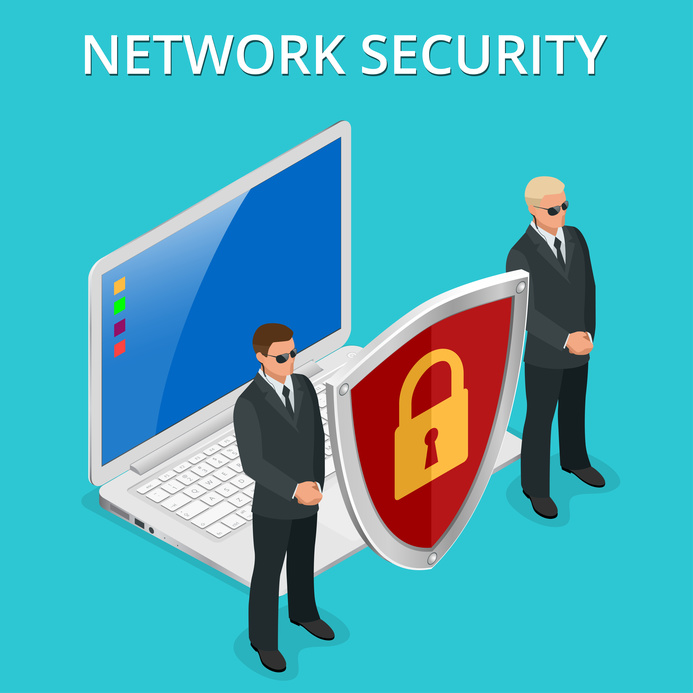
What is Unified Threat Management? Sounds scary doesn’t it? Almost like a swat team dressed in black is going to swing in and start yelling orders. While just as effective at disabling the bad guys, Unified Threat Management (UTM) is a special kind of IT solution focused on proactive protection. Consider it more like a team of virtual bodyguards that stand at the door between your business and the internet, keeping trouble out while your legitimate traffic can come and go normally.
With the increasing number of connected devices in your business network and the different ways your employees now connect, it’s more important than ever to have a dedicated security appliance in place. UTM is a series of solutions that work together, simultaneously layering your protection across the board. We’ll cover the four main inclusions here, and exactly what they can do for your business.
Robust Firewall
Put simply, a firewall keeps an eye on all the data coming in and out, looking for anything abnormal. While every home PC comes with a software firewall built in, those ones pale in comparison to what a UTM firewall can do. Remember the team of virtual bodyguards? Imagine the home firewall asking nicely if the data should be doing that, while the UTM slams the data to the ground and demands credentials. It exists to make sure the data entering your network is safe, that it’s not part of a cyber-attack, and that in the rare event your network becomes infected, your servers aren’t being used to attack another business.
Anti-virus Where it Matters
With so much new malware being released daily, it’s easy to fall behind in updates and discover you’ve been infected. Your employees are likely doing their best, but manually scanning each file can be exhausting and time-consuming. Your Unified Threat Management (UTM) anti-virus is built into the firewall, ensuring known or suspicious malware is stopped at the door. It doesn’t even make it through to your employees, so the risk is removed. Clearly that’s the best outcome possible and will allow your employees to work at maximum efficiency, while you can run your business with confidence.
Spam Blocking
Most cyber-attacks come via email these days, with either an attachment or a link. Once clicked, the malware is released into the network to wreak havoc. Obviously, your employees are smart enough not to open random attachments/links, so hackers use phishing emails. These are emails that look legitimate and may refer to vendors you use, financial services you have accounts with, or even seem to be from other employees. Your UTM isn’t falling for any of those disguises, it strips down each email and checks it against high-tech legitimacy markers. If it sees anything suspicious, the email is marked as spam and either held for review or bounced away.
Your employees never see the attack, so they can’t accidentally fall for it. While the UTM is monitoring for phishing/fake emails, it’s also culling out the general spam that clogs up inboxes. Employees will no longer have to spend precious minutes each day wading through the junk, and the likelihood of missing an important customer email has greatly dropped.
Content Filtering
In a perfect world, your employees would only access work-related sites and do work-related things online. Content filtering can help you limit the risk they’re bringing into your business via these websites. Your UTM can be set to restrict sites that infect computers, such as adult content, gambling or illegal downloads. It can also be used to restrict access to productivity vampires like Facebook or Pinterest, either during work hours or completely. It’s up to your policies how much you’d like to filter and whether to add any flexibility. Some businesses allow social media during lunch breaks or have special reward hours each week. Simple tweaks like this can increase productivity overnight and give you the security you’re looking for.
You can see how a layered security solution like Unified Threat Management provides a space for your business to thrive, where systems are secure, employees are able to maintain efficiency, and cyber problems stay outside the doors. The way the layers work together is more effective than a patchwork of separate systems, and a UTM is much easier to configure and maintain.
Unified Threat Management offers a robust and comprehensive approach to network security, combining multiple security features into a unified platform. With its comprehensive protection, simplified management, scalability, and cost-effectiveness, UTM plays a vital role in defending networks against modern cyber threats.
We can answer all of your additional questions regarding Unified Threat Management. Find the right solution for your business.
🛡️ Ready to Simplify and Strengthen Your Network Security?
Unified Threat Management (UTM) solutions combine firewall, antivirus, intrusion detection, and content filtering into one powerful system. At Landon Technologies, we help businesses protect their data and infrastructure with Cyber Security Services, Managed IT Services, and IT Consulting built for modern threats.
- UTM appliance setup and configuration
- Real-time monitoring and patch management
- Threat detection and incident response
- Compliance-ready network protection
📍 Serving businesses locally in St Augustine, FL and nationwide, we deliver scalable, all-in-one network security.
Get More Info on Our Unified Threat Management Services
Unified Threat Management: Frequently Asked Questions
What is a unified threat management system?
A unified threat management (UTM) system is a network security solution that combines multiple cybersecurity functions into a single platform or appliance. Instead of using separate devices for firewall protection, antivirus, intrusion prevention, content filtering, VPN access, and web security, a UTM system integrates these features into one centralized solution. Businesses often use UTM appliances to simplify security management, improve network protection, and reduce costs while maintaining visibility and control over network traffic and cyber threats.
What is the difference between UTM and firewall?
A traditional firewall primarily focuses on controlling and filtering network traffic based on security rules, while a unified threat management (UTM) system includes a firewall plus multiple additional security features in a single platform. In addition to firewall protection, a UTM typically combines tools such as intrusion prevention, antivirus, web filtering, spam protection, VPN services, and application control. In simple terms, a firewall is one component of network security, while a UTM is a more comprehensive all-in-one security solution designed to protect businesses from a wider range of cyber threats.
Is UTM a virus?
No, UTM is not a virus. UTM stands for Unified Threat Management, which is a cybersecurity solution designed to help protect networks and devices from threats such as viruses, malware, ransomware, and unauthorized access. A UTM system combines multiple security features—such as firewall protection, antivirus scanning, intrusion prevention, VPN services, and web filtering—into a single platform to improve overall network security and simplify management.
What is a UTM in Cisco?
In Cisco environments, UTM (Unified Threat Management) refers to integrated security features that combine multiple forms of network protection into a single appliance or platform. Cisco UTM capabilities may include firewall protection, intrusion prevention (IPS), antivirus scanning, VPN services, web filtering, application control, and advanced threat detection. Cisco has offered UTM-style functionality through products such as the Cisco ASA with FirePOWER services and newer Cisco Secure Firewall platforms, helping businesses simplify security management while protecting networks from a wide range of cyber threats.
🛡️ Cybersecurity
🛡️ Stay Ahead of Cyber Threats
Get the latest security insights and tips in our
👉 Cybersecurity Blog Category